
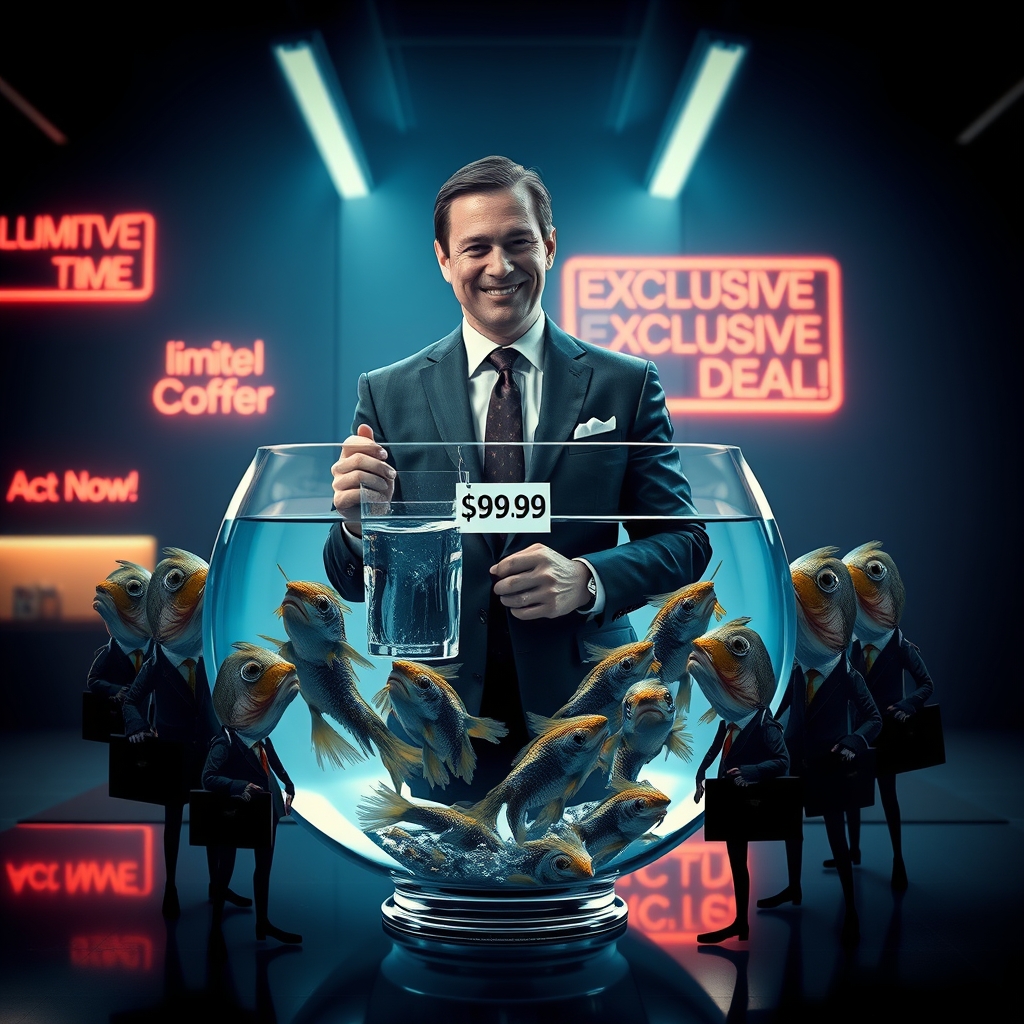
Ah, the noble art of selling—where the line between genius and insanity is thinner than a used-car salesman’s patience. If you’ve ever wondered how to convince someone they *need* something they already have, you’re in the right place. Welcome to the twisted world of sales strategy, where logic goes to die and persuasion wears a very convincing mask.
Today, we’re not just selling products; we’re selling illusions, aspirations, and occasionally, the emperor’s new clothes. And if you think that’s cynical, wait until you hear about the fish who paid for water. Spoiler: It’s you. It’s always been you.
The Golden Rule of Sales Strategy: Make Them Think It Was Their Idea
Let’s start with the basics. The best salespeople don’t sell—they manipulate the buyer into believing they’ve stumbled upon the greatest idea since sliced bread. Or, in this case, since the invention of the upsell. It’s not about the product; it’s about the story you wrap around it like a shiny, irresistible bow.
Take the classic example of the gym membership. No one *wants* to pay for a place they’ll visit twice before forgetting the password to the treadmill. But slap on a “New Year, New You” narrative, and suddenly, people are throwing money at the problem like it’s a piñata filled with regret and protein shakes. That, my friends, is sales strategy in its purest form: selling the dream before the customer realizes the product is just a treadmill with a screen.
And if you’re thinking, “But I’m not selling gym memberships,” congratulations—you’ve already lost. Because in the world of sales, *everything* is a gym membership. Your product is just the treadmill. The real magic is making them believe they’ll finally lose those 10 pounds.
Why Your Sales Strategy is Failing (Hint: You’re Not Lying Hard Enough)
Here’s a hard truth: If your sales strategy isn’t working, it’s because you’re not being creative enough with the truth. Customers don’t want honesty; they want a performance. They want to feel like they’re part of an exclusive club, even if that club is just a mailing list with a 20% discount code.
Look at the tech industry. Companies don’t sell phones; they sell “revolutionary experiences.” They don’t sell laptops; they sell “the future of productivity.” And yet, somehow, we all still end up with a device that crashes when we open more than three tabs. But hey, at least it came with a free sticker, right?
The key to a successful sales strategy is to make the customer feel like they’re getting something *more* than just a product. They’re getting a lifestyle, a status symbol, or a vague sense of superiority. And if you can do that while charging them 30% more for the “premium” version, well, then you’ve truly mastered the art.
The Fine Art of the Upsell: Because One Sale is Never Enough
Ah, the upsell—the salesperson’s equivalent of a magician pulling a rabbit out of a hat, except the rabbit is a $200 extended warranty and the hat is your customer’s wallet. The upsell isn’t just a tactic; it’s a sales strategy superpower. And like all superpowers, it’s best used responsibly (or not at all, if you’re feeling particularly ethical).
Picture this: A customer walks into a store to buy a pair of shoes. They leave with the shoes, a matching belt, a “limited edition” shoelace set, and a subscription to the store’s “VIP Lifestyle Club.” How? Because the salesperson didn’t just sell them shoes—they sold them an identity. And identities, apparently, come with a lot of accessories.
The upsell works because it preys on the customer’s fear of missing out. “You *could* just buy the basic model,” the salesperson whispers, “but do you really want to be the kind of person who *settles*?” Suddenly, the customer isn’t just buying a product; they’re buying permission to feel good about themselves. And that, my friends, is priceless.
Sales Strategy in the Digital Age: Where Algorithms Do the Lying for You
Gone are the days when salespeople had to rely on charm, wit, and the occasional sleazy smile. Today, sales strategy is a numbers game, and the numbers are crunched by algorithms that know you better than your own mother. Ever notice how Facebook ads seem to know exactly what you were *just* thinking about buying? That’s not magic; that’s data-driven manipulation.
Digital sales strategies thrive on personalization. The more the algorithm knows about you, the easier it is to sell you something you didn’t even know you wanted. It’s like having a salesperson who follows you around 24/7, whispering in your ear, “You *need* this. You *deserve* this. And look, it’s on sale for the next 10 minutes!”
But here’s the kicker: The digital age hasn’t just changed how we sell; it’s changed how we *buy*. Customers are savvier than ever, which means your sales strategy needs to be smarter than ever. No more generic pitches; no more one-size-fits-all solutions. Today’s customer wants to feel like they’re being spoken to directly, even if the message is the same one you’re sending to a million other people.
The Dark Side of Personalization: When the Algorithm Knows Too Much
Of course, there’s a fine line between personalization and creepiness. Cross it, and your sales strategy goes from “brilliant” to “Big Brother” in 0.2 seconds. No one wants to feel like they’re being stalked by their toaster. (“Hey, we noticed you like toast. How about a *premium* bread subscription?”)
The key is to make personalization feel organic. Customers should feel like they’ve discovered your product on their own, even if the algorithm has been nudging them in that direction for weeks. It’s the digital equivalent of a salesperson “just happening” to be in the store when the customer walks in. Coincidence? Hardly. But it *feels* like one, and that’s what matters.
So, What’s the Secret to a Winning Sales Strategy?
If you’ve made it this far, you’re probably expecting some grand revelation—a secret formula that will turn you into the next sales guru. Well, here it is: There is no secret. The best sales strategy is the one that works, and what works today might not work tomorrow. The market changes, customers evolve, and what was once a brilliant tactic becomes a tired cliché.
But if there’s one thing that never goes out of style, it’s the ability to make the customer feel like they’re getting something special. Whether it’s through storytelling, personalization, or just good old-fashioned charm, the goal is the same: Make them believe. Because in the end, sales isn’t about the product—it’s about the story. And if you can sell that story, you can sell anything. Even a glass of water to a fish.
So go forth, armed with your newfound knowledge of sales strategy. Just remember: The fish is always watching. And it’s *not* happy about this arrangement.